
Introduction
Search in 2026 looks completely different from what it was just a few years ago. Users are no longer just typing keywords into search engines—they’re asking full questions, using voice assistants, and relying on AI tools to deliver instant, complete answers. This shift has transformed how businesses need to think about visibility online.
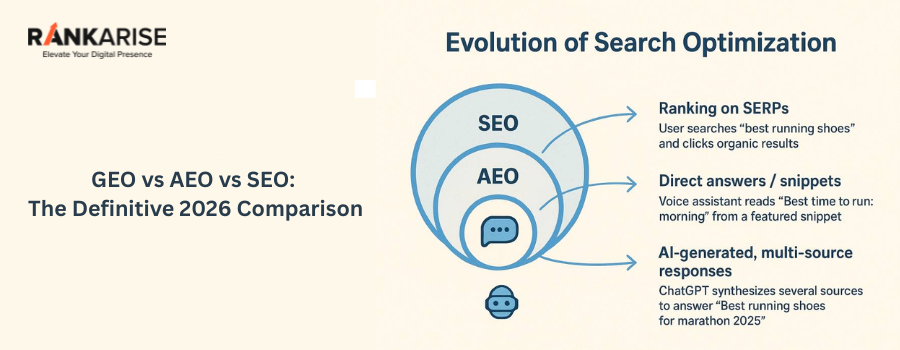
Traditionally, Search Engine Optimization (SEO) was enough to drive traffic and rankings. Then came Answer Engine Optimization (AEO), focused on capturing featured snippets and voice search results. Now, a new layer has emerged: Generative Engine Optimization (GEO)—where the goal is to get your content recognized, trusted, and cited by AI-powered platforms.
Today, ranking #1 on Google is no longer the only objective. If your brand isn’t appearing in AI-generated responses, you’re missing a major share of modern search visibility.
What is SEO (Search Engine Optimization)?
SEO is the foundation of digital visibility. It involves optimizing your website so it ranks higher on search engines like Google and Bing. If you want a deeper understanding, read our detailed guide on how SEO works for SaaS startups
Key Components of SEO:
- Keyword research and targeting
- On-page optimization (titles, meta tags, headings)
- Technical SEO (site speed, indexing, mobile-friendliness)
- Link building and authority
- User experience (UX)
Primary Goal:
To increase organic traffic by improving rankings on search engine results pages (SERPs).
Example:
If someone searches “digital marketing services in India”, SEO helps your website appear in the top results.
What is AEO (Answer Engine Optimization)?
AEO is about optimizing your content to provide direct, concise answers to user queries. It is especially important for:
- Featured snippets
- Voice search
- AI assistants
Key Components of AEO:
- Structured data (schema markup)
- FAQ sections
- Clear, question-based headings
- Short, precise answers
Primary Goal:
To become the selected answer by search engines or voice assistants.
Example:
If a user asks “What is SEO?”, AEO helps your content appear as a featured snippet or spoken response.
What is GEO (Generative Engine Optimization)?
GEO is the newest evolution in search strategy. It focuses on optimizing content for AI-driven platforms that generate answers instead of listing links.
These include AI tools like ChatGPT, Google’s generative search, and other AI-powered engines.
Key Components of GEO:
- Context-rich, in-depth content
- Entity-based SEO
- Topical authority
- Brand mentions across trusted platforms
- High E-E-A-T signals
Primary Goal:
To get your brand mentioned, cited, or recommended by AI systems.
Example:
When someone asks an AI tool “Best SEO strategies for startups”, GEO ensures your brand is included in the answer.
GEO vs AEO vs SEO: Key Differences
| Feature | SEO | AEO | GEO |
| Focus | Rankings | Direct Answers | AI-generated responses |
| Platform | Search engines | Voice & snippets | AI tools |
| Content Type | Keyword-focused | Concise answers | Contextual & semantic |
| Strategy | Backlinks & optimization | Structured data | Authority & entities |
| Outcome | Website traffic | Visibility in snippets | AI mentions |
Why GEO is Dominating in 2026
Search is shifting toward zero-click experiences, where users get answers instantly without visiting a website.
Key Trends:
- Rise of AI-powered search tools
- Increase in voice search usage
- Decrease in traditional click-through rates
- Higher importance of brand authority
This means visibility is no longer just about ranking—it’s about being part of the answer.
How SEO, AEO, and GEO Work Together
These three strategies are not competitors—they complement each other.
1. SEO Builds the Foundation
Without SEO, your content won’t be discovered or indexed.
2. AEO Captures Instant Answers
It ensures your content is selected for snippets and voice results.
3. GEO Expands AI Visibility
It helps your brand appear in AI-generated responses and recommendations.
Together, they create a complete search dominance strategy.
How to Optimize for All Three (Step-by-Step)
Step 1: Start with SEO Basics
- Target relevant keywords
- Optimize meta tags and headings
- Improve website speed and mobile usability
Step 2: Add AEO Optimization
- Include FAQ sections
- Use schema markup
- Answer questions clearly and directly
Step 3: Implement GEO Strategy
- Build topical authority (cluster content)
- Focus on entities, not just keywords
- Get mentioned on authoritative websites
- Publish expert-level, original content
Content Strategy That Works in 2026
Focus on:
- In-depth, valuable content
- Clear structure and readability
- Real expertise and insights
- Strong brand positioning
Content Formats to Use:
- Guides and tutorials
- Case studies
- FAQs and how-to content
- Comparison articles (like this one)
Common Mistakes to Avoid
- Ignoring AI-driven search
- Writing only for keywords, not users
- Not using structured data
- Publishing low-quality or generic content
- Neglecting brand authority
Real-World Use Case
Imagine you run a digital marketing agency:
- SEO helps your website rank for service-based keywords
- AEO gets your content featured in quick answers
- GEO ensures your brand is recommended by AI tools
The result: Maximum visibility across all search platforms
Future of Search (Beyond 2026)
- AI-generated search will dominate
- Voice and conversational queries will grow
- Brand trust will outweigh backlinks
- Content will shift from keyword-based to intent-based
Businesses that adapt early will gain a massive competitive advantage.
Conclusion
The search landscape is evolving rapidly, and relying on just one strategy is no longer enough.
- SEO drives traffic
- AEO captures attention
- GEO builds authority in AI ecosystems
To succeed in 2026, businesses must adopt a holistic approach that combines all three.
The future belongs to brands that are not just searchable—but answerable and recommendable.
FAQs
1. What is the biggest difference between SEO, AEO, and GEO?
SEO focuses on rankings, AEO focuses on answers, and GEO focuses on AI-generated visibility.
2. Is SEO still relevant in 2026?
Yes, SEO is still the foundation but must be combined with AEO and GEO.
3. What is GEO in simple terms?
GEO is optimizing your content so AI tools mention and recommend your brand.
4. How do I start with AEO?
Create FAQ sections, use structured data, and provide clear answers.
5. Why is GEO important for the future?
Because AI-driven search is growing rapidly and influencing user decisions.