
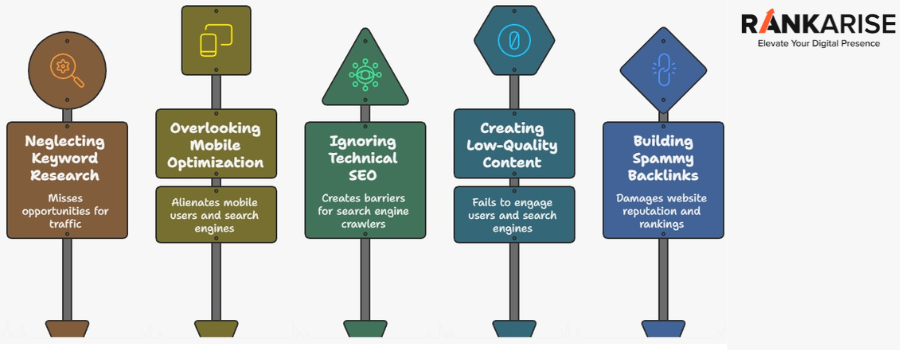
Many websites struggle with rankings because of common SEO mistakes. Search Engine Optimization (SEO) is one of the most powerful strategies for driving organic traffic to your website. However, many businesses struggle to achieve good rankings because they unknowingly make common SEO mistakes.
Even small errors can negatively impact your website’s visibility in search engines and reduce the chances of attracting potential customers. If your website is not ranking well despite your efforts, these mistakes might be the reason.
In this guide, we will explore the most common SEO mistakes that hurt your rankings and how you can fix them to improve your website’s performance.
Why Avoiding SEO Mistakes Is Important
Search engines constantly update their algorithms to provide users with the most relevant and high-quality results. When websites follow outdated practices or ignore important SEO factors, their rankings can drop significantly.
Avoiding SEO mistakes helps you:
- Improve search engine rankings
- Increase organic traffic
- Provide better user experience
- Build long-term online authority
- Generate more leads and conversions
Now let’s look at the most common mistakes that businesses make.
1. Ignoring Keyword Research
Keyword research is the foundation of any successful SEO strategy. Many businesses create content without understanding what their target audience is searching for.
Without proper keyword research, your content may not match search intent, making it difficult for search engines to rank your pages.
How to Fix It
Use keyword research tools to identify relevant search terms your audience uses. Focus on keywords that have:
- Good search volume
- Low to medium competition
- Clear user intent
Including these keywords naturally in your content helps search engines understand what your page is about.
2. Keyword Stuffing
In the past, repeating the same keyword multiple times was a common SEO practice. Today, search engines are much smarter and can easily detect keyword stuffing.
Overusing keywords makes your content look unnatural and can lead to penalties or lower rankings.
How to Fix It
Instead of repeating keywords excessively:
- Write naturally for readers
- Use variations of keywords
- Focus on providing valuable information
Search engines now prioritize content that answers user queries effectively.
3. Poor Quality Content
Content is one of the most important ranking factors. Thin, duplicate, or poorly written content can significantly harm your SEO performance.
If your content does not provide value or answer user questions, visitors will leave quickly, increasing your bounce rate.
How to Fix It
Create high-quality content that is:
- informative
- well structured
- original
- helpful to readers
Focus on solving real problems and providing actionable insights.
4. Not Optimizing Title Tags and Meta Descriptions
Title tags and meta descriptions play an important role in SEO because they tell search engines what your page is about and encourage users to click on your result.
Many websites either ignore them or use generic titles that do not include relevant keywords.
How to Fix It
Write optimized titles that:
- include your main keyword
- clearly describe the page content
- attract users to click
Meta descriptions should be compelling and informative to improve click-through rates.
5. Slow Website Speed
Website speed is a critical ranking factor. If your website takes too long to load, users are likely to leave before the page even appears.
Search engines consider slow websites as providing poor user experience, which can negatively affect rankings.
How to Fix It
Improve your website speed by:
- compressing images
- using fast hosting
- enabling caching
- minimizing unnecessary scripts
A faster website improves both user experience and SEO performance.
6. Not Mobile-Friendly
Most internet users browse websites using smartphones. If your website is not mobile-friendly, it can lose a large portion of potential visitors.
Search engines prioritize mobile-friendly websites because they provide better accessibility for users.
How to Fix It
Ensure your website:
- has responsive design
- loads properly on all devices
- has readable text and easy navigation
Mobile optimization is essential for modern SEO.
7. Ignoring Local SEO
Many small businesses rely on local customers, but they fail to optimize their websites for local searches.
Without local SEO, your business may not appear when people search for services in your area.
How to Fix It
Improve your local SEO by:
- creating and optimizing your Google Business Profile
- using location-based keywords
- encouraging customer reviews
- listing your business in local directories
These steps help your business appear in local search results.
8. Poor Website Structure
A poorly organized website makes it difficult for search engines to crawl and understand your content.
If your pages are not structured properly, important information may remain hidden from search engines.
How to Fix It
Use a clear website structure with:
- organized categories
- logical navigation
- internal links between pages
This helps search engines discover and index your content more effectively.
9. Not Using Internal Links
Internal linking connects different pages on your website and helps search engines understand the relationship between your content.
Many websites fail to use internal links properly, which can limit their SEO potential.
How to Fix It
Add internal links that guide readers to related content on your website.
For example:
- link blog posts to service pages
- connect related articles
- use descriptive anchor text
Internal linking improves both user experience and SEO.
10. Lack of Backlinks
Backlinks are links from other websites that point to your site. They are one of the strongest ranking signals for search engines.
Websites without quality backlinks often struggle to compete in search results.
How to Fix It
Focus on earning high-quality backlinks through:
- guest blogging
- industry collaborations
- shareable content
- digital PR
Quality backlinks increase your website’s authority and credibility.
11. Ignoring Technical SEO
Technical SEO ensures that search engines can crawl and index your website properly.
Issues such as broken links, duplicate pages, and missing sitemaps can hurt your rankings.
How to Fix It
Regularly perform technical SEO audits and fix issues like:
- broken links
- duplicate content
- missing meta tags
- crawl errors
Technical improvements help search engines understand your website better.
12. Not Updating Content Regularly
Search engines prefer fresh and updated content. Websites that never update their content may gradually lose rankings.
Outdated information can also reduce user trust.
How to Fix It
Update your existing content by:
- adding new information
- improving readability
- updating statistics and examples
Refreshing old content can significantly improve rankings.
Conclusion
Avoiding common SEO mistakes is essential if you want your website to rank higher in search engines and attract consistent organic traffic. Small issues like poor keyword research, ignoring mobile optimization, weak technical SEO, low-quality content, and spammy backlinks can significantly harm your rankings. By identifying and fixing these problems, you can improve your website’s visibility, user experience, and overall performance. Focus on creating high-quality content, optimizing your website for both users and search engines, and following SEO best practices to achieve long-term success.
Frequently Asked Questions (FAQs)
What are the most common SEO mistakes?
Some of the most common SEO mistakes include neglecting keyword research, ignoring mobile optimization, poor technical SEO, publishing low-quality content, and building spammy backlinks.
Can SEO mistakes affect website rankings?
Yes, SEO mistakes can negatively impact your website rankings. Search engines prioritize websites that provide high-quality content, good user experience, and proper optimization.
How can I fix SEO mistakes on my website?
You can fix SEO mistakes by conducting proper keyword research, improving site speed and mobile responsiveness, optimizing technical SEO, creating valuable content, and building high-quality backlinks.
How long does it take to see SEO improvements?
SEO improvements usually take a few weeks to several months, depending on the competition, website quality, and the effectiveness of your optimization strategies.
Why is technical SEO important?
Technical SEO helps search engines crawl and index your website efficiently. Without proper technical optimization, even high-quality content may struggle to rank.