
Introduction
Driving traffic to your website is important—but what truly matters is how many of those visitors take action. Whether it’s making a purchase, signing up for a newsletter, or filling out a contact form, conversions are the ultimate goal.
This is where Conversion Rate Optimization (CRO) comes in.
CRO is the process of improving your website or landing page to increase the percentage of visitors who complete a desired action. Instead of spending more on ads or SEO, CRO helps you maximize results from your existing traffic with the right digital marketing services.
In this guide, we’ll walk you through a step-by-step CRO strategy to boost conversions and grow your business.
What is Conversion Rate Optimization?
Conversion Rate Optimization (CRO) is the systematic process of enhancing your website’s performance by improving user experience, design, and messaging to increase conversions.
Conversion Rate Formula:
Conversion Rate = (Conversions ÷ Total Visitors) × 100
Example:
If 1000 people visit your site and 50 convert → Conversion Rate = 5%
Why CRO is Important
- Improves ROI without increasing traffic
- Reduces customer acquisition costs
- Enhances user experience (UX)
- Increases revenue and leads
- Gives data-driven insights
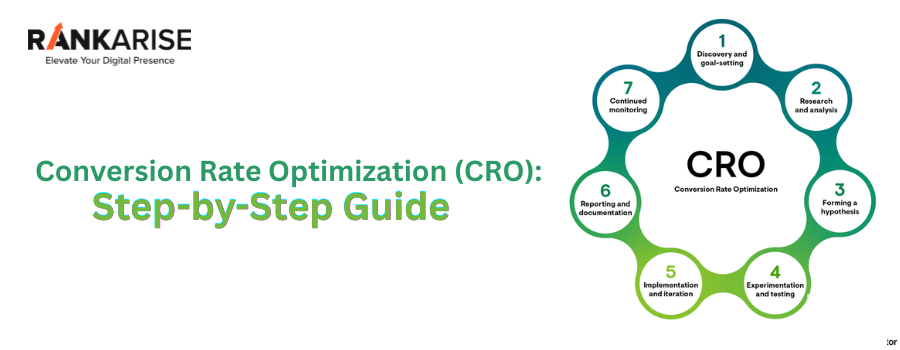
Step-by-Step CRO Process
Step 1: Define Your Goals
Before optimizing, identify what you want users to do.
Common Conversion Goals:
- Purchase a product
- Fill out a form
- Subscribe to a newsletter
- Download an eBook
- Book a consultation
👉 Tip: Use SMART goals (Specific, Measurable, Achievable, Relevant, Time-bound)
Step 2: Analyze User Behavior
Understand how users interact with your website.
Tools You Can Use:
- Google Analytics
- Heatmaps (Hotjar, Crazy Egg)
- Session recordings
- Scroll tracking
What to Look For:
- High bounce rates
- Drop-off points in funnels
- Pages with low engagement
Step 3: Identify Conversion Barriers
Find out what’s stopping users from converting.
Common Issues:
- Slow loading speed
- Poor mobile experience
- Confusing navigation
- Weak call-to-action (CTA)
- Lack of trust signals
Step 4: Create a Hypothesis
Based on your analysis, form a testable idea.
Example:
“If we change the CTA button color to red, conversions will increase because it stands out more.”
Step 5: Run A/B Testing
A/B testing (split testing) compares two versions of a page to see which performs better.
A/B testing is a core part of performance marketing strategies to improve campaign results.
What You Can Test:
- Headlines
- CTA buttons
- Images
- Layout/design
- Forms
Tools:
- Google Optimize (or alternatives)
- VWO
- Optimizely
Step 6: Optimize Landing Pages
Your landing page plays a crucial role in conversions.
Best Practices:
- Clear and compelling headline
- Strong value proposition
- Minimal distractions
- High-quality visuals
- Trust signals (reviews, testimonials)
Step 7: Improve Call-to-Actions (CTAs)
CTAs guide users toward conversion.
Tips for Better CTAs:
- Use action-oriented language (“Get Started”, “Claim Now”)
- Make buttons visually appealing
- Place CTAs strategically
- Create urgency (Limited Time Offer)
Step 8: Enhance User Experience (UX)
A smooth user experience increases trust and conversions.
Key UX Factors:
- Fast loading speed
- Mobile responsiveness
- Easy navigation
- Clean design
Step 9: Build Trust and Credibility
Users convert only when they trust your brand.
Add:
- Customer testimonials
- Case studies
- Security badges
- Money-back guarantees
- Client logos
Step 10: Optimize Forms
Forms are often the final step before conversion.
Best Practices:
- Keep forms short
- Ask only necessary information
- Use autofill where possible
- Add clear error messages
Step 11: Use Personalization
Tailor content based on user behavior.
Examples:
- Show different offers for new vs returning users
- Location-based content
- Product recommendations
Step 12: Monitor & Continuously Improve
CRO is not a one-time process.
Track Metrics:
- Conversion rate
- Bounce rate
- Average session duration
- Exit pages
Keep testing and improving regularly.
Common CRO Mistakes to Avoid
- Ignoring mobile optimization
- Making changes without data
- Testing too many variables at once
- Not tracking results properly
- Overcomplicating design
CRO Tools You Should Know
- Google Analytics – User data insights
- Hotjar – Heatmaps & recordings
- Crazy Egg – User behavior tracking
- Optimizely – A/B testing
- VWO – Conversion optimization platform
Conclusion
Conversion Rate Optimization (CRO) is one of the most powerful strategies to grow your business without increasing traffic.
By following this step-by-step CRO guide, you can:
- Understand your users better
- Identify weak points in your funnel
- Test and implement improvements
- Increase conversions and revenue
Remember, small changes can lead to big results. Start testing today and continuously optimize your website for better performance.
Want to boost your conversions? Get a free consultation today.
FAQs
1. What is a good conversion rate?
A good conversion rate typically ranges between 2% to 5%, but it varies by industry.
2. How long does CRO take?
CRO is an ongoing process. Initial results may take a few weeks, but continuous optimization brings long-term success.
3. Is CRO better than SEO?
Both are important. SEO brings traffic, while CRO converts that traffic into customers.
4. What is A/B testing in CRO?
A/B testing compares two versions of a webpage to determine which one performs better.