
Introduction
Entity SEO is changing how Google understands brands beyond simple keywords. Modern search engines rely on entities, context, and semantic understanding to interpret content.Search engine optimization (SEO) has evolved significantly over the past decade. Earlier, ranking on search engines mainly depended on keyword usage and backlinks. However, modern search engines like Google now rely heavily on entities, context, and semantic understanding to interpret search queries and web content.
This shift has introduced the concept of Entity SEO. Instead of simply matching keywords, Google focuses on identifying people, brands, locations, products, and concepts as entities and understanding their relationships.
For businesses and marketers, Entity SEO is becoming a crucial strategy to improve search visibility, authority, and brand recognition in search results.
What is Entity SEO?
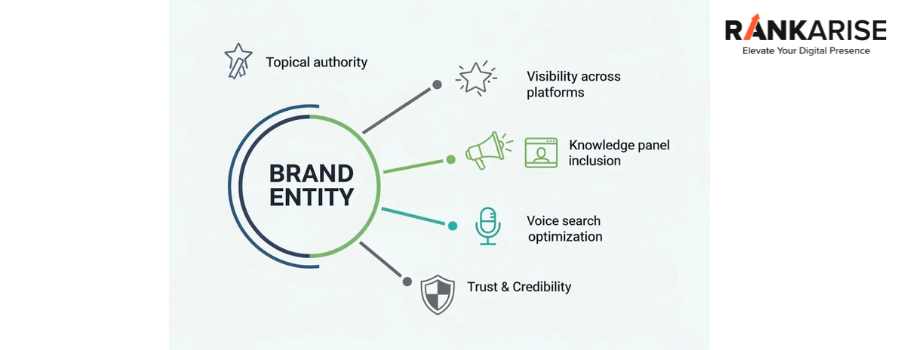
Entity SEO is the process of optimizing content so that search engines can clearly understand who or what a brand represents.
An entity is anything that can be uniquely identified. Search engines use entities to connect information across the web and deliver more accurate results.
Examples of entities include:
- Brands (Nike, Apple)
- People (Elon Musk)
- Locations (Ahmedabad, New York)
- Organizations (World Health Organization)
- Concepts (Digital Marketing, Artificial Intelligence)
When Google identifies an entity, it connects it with related information using technologies like the Knowledge Graph.
How Google Understands Entities
Google uses advanced technologies to recognize entities and understand how they relate to each other.
1. Knowledge Graph
The Knowledge Graph is a large database that stores billions of facts about entities and their relationships.
For example, if someone searches for a brand, Google may display:
- Knowledge panels
- Related searches
- Brand information
- Social media profiles
This helps users quickly find trusted information.
2. Natural Language Processing (NLP)
Google uses Natural Language Processing to understand the meaning behind search queries. Instead of focusing only on exact keywords, the algorithm interprets context and intent.
For example, if a user searches for “best SEO agency in Ahmedabad,” Google understands that the search refers to:
- SEO services
- Local businesses
- Agencies located in Ahmedabad
3. Semantic Search
Semantic search helps Google analyze relationships between topics and entities.
If your website consistently publishes content around SEO, digital marketing, and AI search optimization, Google will recognize your brand as an entity related to those topics.
Why Entity SEO is Important
Entity SEO plays an important role in modern search engine optimization.
Better Search Understanding
Google can clearly understand your brand, services, and expertise.
Improved Rankings
Content optimized around entities is often more relevant and informative, which improves ranking potential.
Strong Brand Authority
When Google recognizes your brand as an entity, it increases credibility and trust.
Voice Search Optimization
Voice search assistants rely heavily on entity recognition to provide answers.
AI Search Visibility
AI search tools and assistants depend on entity relationships to generate answers and recommendations.
Entity SEO vs Traditional Keyword SEO
| Traditional Keyword SEO | Entity SEO |
| Focus on repeating keywords | Focus on topics and relationships |
| Keyword density optimization | Context and meaning |
| Short-term ranking tactics | Long-term authority building |
| Limited understanding of intent | Deep understanding of user intent |
Entity SEO helps search engines understand the bigger picture of your content and brand identity.
How to Implement Entity SEO
Businesses can improve their entity SEO by following several strategies.
1. Build Topical Authority
Create multiple pieces of content around the same topic. For example, if your website focuses on SEO, you can publish blogs about:
- Technical SEO
- Local SEO
- AI SEO
- Content SEO
- SEO tools
This helps search engines connect your website with the broader topic.
2. Use Structured Data (Schema Markup)
Structured data helps search engines identify entities on your website.
Common schema types include:
- Organization schema
- Person schema
- Article schema
- Product schema
This structured information makes it easier for search engines to understand your content.
3. Optimize Internal Linking
Link related articles and pages together. Internal linking helps search engines understand the relationship between different pieces of content on your website.
4. Build Brand Mentions
Getting your brand mentioned on other websites helps strengthen entity recognition.
Examples include:
- Guest blogging
- Industry directories
- News articles
- Social media profiles
5. Maintain Consistent Brand Information
Ensure your brand name, logo, website URL, and contact details are consistent across all platforms.
Consistency helps search engines verify your brand as a recognized entity.
The Future of SEO is Entity-Based
Search engines are becoming smarter with artificial intelligence and semantic understanding. Instead of relying only on keywords, they now focus on entities, relationships, and user intent.
Businesses that focus on building strong brand entities and topical authority will gain a competitive advantage in search results.
As search technology continues to evolve, entity SEO will play an even bigger role in content discovery, AI search, and digital marketing strategies.
Conclusion
Entity SEO is transforming the way search engines understand websites and brands. By focusing on entities rather than just keywords, businesses can build stronger authority and improve their visibility in search results.
Implementing strategies like structured data, topical content, brand mentions, and internal linking can help search engines recognize your brand as a trusted entity.
In the evolving world of SEO, businesses that adopt entity-based optimization will be better positioned for long-term success in search rankings.
Blog FAQ Section
What is Entity SEO?
Entity SEO is a modern search optimization technique that focuses on helping search engines understand real-world entities such as brands, people, places, and concepts instead of relying only on keywords.
Why is Entity SEO important?
Entity SEO improves search engine understanding, increases brand authority, and helps websites appear in knowledge panels, featured snippets, and AI search results.
What is the Google Knowledge Graph?
The Knowledge Graph is a database used by search engines to connect entities and facts. It helps search engines provide more relevant search results.
How does Google identify entities?
Google uses technologies like natural language processing, semantic search, and structured data to recognize and connect entities across the web.
Can Entity SEO improve rankings?
Yes. By helping search engines understand the context and relationships between topics, entity SEO can improve visibility and long-term rankings.