
Introduction
For years, SEO has been treated as a traffic-generation machine. Rank higher, get more clicks, and hope those visitors convert. But in 2026, that mindset is outdated.
Traffic alone doesn’t pay the bills, If you’re still focusing only on traffic, you should understand the difference explained in SEO vs CRO: Which One Actually Makes More Money in 2026.
Modern businesses need a full-funnel SEO system that doesn’t just attract visitors but guides them from awareness to purchase and beyond. If your SEO strategy stops at rankings, you’re leaving serious money on the table.
This guide breaks down how to turn SEO into a revenue-driving engine by aligning it with every stage of the customer journey.
What Is Full-Funnel SEO?
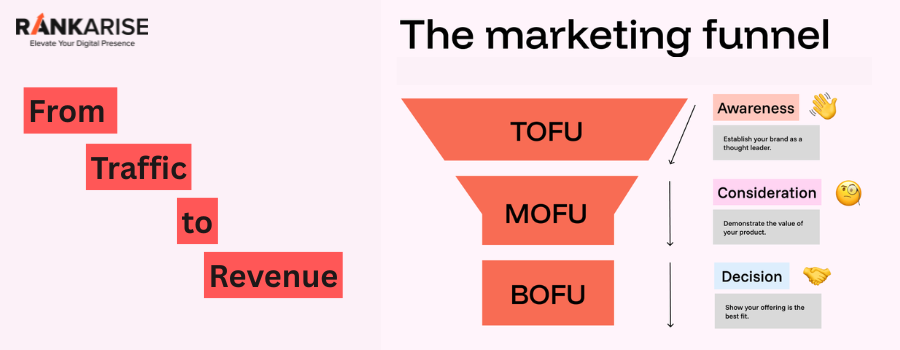
Full-funnel SEO is the process of optimizing content for every stage of the buyer journey:
- Top of Funnel (TOFU) – Awareness
- Middle of Funnel (MOFU) – Consideration
- Bottom of Funnel (BOFU) – Conversion
- Post-Funnel – Retention & expansion
Instead of chasing random keywords, you build a system where each piece of content plays a role in moving users closer to revenue.
Why Traditional SEO Fails
Most SEO strategies fail because they:
- Focus only on high-volume keywords
- Ignore user intent
- Lack conversion pathways
- Don’t connect content pieces
Result?
High traffic, low revenue.
You might get thousands of visitors—but if they’re not ready to buy or don’t know what to do next, they leave.
Step 1: Map Keywords to Intent (Not Just Volume)
The foundation of a revenue-driven SEO system is search intent.
Intent Types:
- Informational – “What is CRO?”
- Commercial – “Best CRO tools 2026”
- Transactional – “Buy CRO software”
- Navigational – Brand-specific searches
Strategy:
- Target informational keywords for traffic
- Target commercial + transactional keywords for revenue
The key is balance. Traffic brings visibility, but intent drives conversions.
You can explore more latest SEO strategies to refine how you approach keyword intent.
Step 2: Build TOFU Content That Attracts the Right Audience
Top-of-funnel content should:
- Answer broad questions
- Educate your audience
- Build trust
Examples:
- Guides
- How-to articles
- Industry trends
- Beginner tutorials
Pro Tip:
Don’t chase any traffic—target people who are potential buyers, not just readers.
Step 3: Create MOFU Content That Builds Consideration
This is where most businesses fall short.
MOFU content helps users evaluate solutions and positions your brand as the best choice.
Content Types:
- Comparison blogs
- Case studies
- Product roundups
- “Best tools” lists
Goal:
Move users from “just researching” → “considering your solution”
Step 4: Optimize BOFU Pages for Conversions
This is where revenue happens.
Your bottom-of-funnel pages must be:
- Highly targeted
- Clear and persuasive
- Optimized for conversions
Examples:
- Service pages
- Product pages
- Landing pages
- Pricing pages
Must-Have Elements:
- Strong CTA (Call-to-Action)
- Social proof (reviews, testimonials)
- Clear benefits (not just features)
- Fast loading speed
Working with an experienced SEO agency can significantly improve your conversion rates at this stage
Step 5: Build Smart Internal Linking Paths
SEO isn’t just about content—it’s about connections.
Guide users through your funnel using internal links:
- TOFU → MOFU
- MOFU → BOFU
- BOFU → Conversion
Example Flow:
Blog post → Comparison article → Service page → Contact form
This turns your website into a conversion journey, not just a content library.
Step 6: Use Content Clusters to Dominate Topics
Instead of isolated posts, build topic clusters:
- One pillar page (broad topic)
- Multiple supporting articles (subtopics)
Benefits:
- Better rankings
- Strong topical authority
- Improved user journey
Google favors websites that demonstrate depth, not just breadth.
Step 7: Align SEO with CRO (Conversion Rate Optimization)
Getting traffic is step one. Converting it is where growth happens.
CRO + SEO Tactics:
- Optimize headlines for clicks and engagement
- Add lead magnets (ebooks, tools, templates)
- Use heatmaps to track user behavior
- A/B test CTAs
SEO brings users in. CRO turns them into customers.
Step 8: Track Revenue, Not Just Rankings
Most marketers track:
- Traffic
- Rankings
- Clicks
But revenue-focused SEO tracks:
- Conversion rate
- Customer acquisition cost (CAC)
- Revenue per visitor
- Lifetime value (LTV)
Key Insight:
A keyword with 500 visits and 10 sales is more valuable than one with 5,000 visits and zero conversions.
Step 9: Optimize for AI Search & Zero-Click Results
Search is changing rapidly with AI platforms.
To stay ahead:
- Optimize for featured snippets
- Structure content clearly
- Use FAQs and schema markup
- Provide direct, concise answers
Even if users don’t click, strong visibility builds brand authority and trust.
Step 10: Retain and Monetize Existing Traffic
Your funnel doesn’t end at conversion.
Post-Funnel Strategies:
- Email marketing
- Retargeting ads
- Upselling & cross-selling
- Loyalty programs
Acquiring a customer is expensive—retaining them is where profits grow.
Common Mistakes to Avoid
- Chasing traffic without intent
- Ignoring bottom-funnel content
- Weak CTAs
- Poor internal linking
- No tracking of revenue metrics
Conclusion
SEO in 2026 isn’t about ranking—it’s about revenue systems.
A full-funnel SEO strategy ensures that:
- Every keyword has a purpose
- Every page moves users forward
- Every visitor has a path to conversion
If you shift your focus from traffic to customer journeys, SEO becomes one of the most powerful growth channels in your business.
FAQs
1. What is full-funnel SEO?
It’s an SEO strategy that targets all stages of the buyer journey—from awareness to conversion and retention.
2. Why is my SEO traffic not converting?
Because it likely targets informational keywords without guiding users toward transactional actions.
3. How long does it take to see revenue from SEO?
Typically 3–6 months, but a well-structured funnel can accelerate results.
4. Is SEO still relevant in 2026?
Yes—but only when combined with intent, user experience, and conversion optimization.