
Introduction
Search behavior is evolving rapidly. Platforms like ChatGPT, Perplexity AI, and Google AI Overviews no longer just show links—they generate direct answers.
These AI systems choose trusted sources to cite. If your website is not seen as an authority, it won’t be included.
This is where Topical Authority becomes critical.
By building structured content clusters, you can position your website as a reliable source that AI tools trust and cite. To implement this effectively, businesses often rely on professional digital marketing services to build strong content strategies.
What is Topical Authority?
Topical Authority means your website demonstrates deep expertise in a specific subject.
Instead of publishing random content, you:
- Focus on a niche
- Cover all related subtopics
- Connect them strategically
For example, if your niche is SEO, you should cover:
- On-page SEO
- Technical SEO
- Link building
- Keyword research
- Local SEO
This creates a strong, interconnected knowledge base.
What Are Content Clusters?
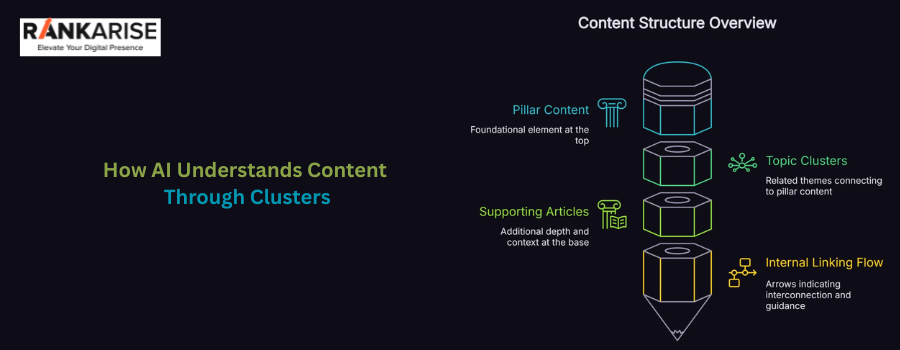
Content clusters are a way of organizing your website around a central topic and multiple supporting articles.
Structure of Content Clusters
1. Pillar Page
- A comprehensive guide on the main topic
- Targets broad keywords
2. Cluster Pages
- Detailed articles on subtopics
- Focus on long-tail keywords
3. Internal Linking
- Connects all pages within the cluster
This structure helps both users and AI understand your content better.
Why AI Cites Content Clusters
AI platforms analyze more than keywords. They focus on:
- Context
- Depth
- Content relationships
Websites with strong content clusters:
- Provide complete information
- Show logical structure
- Demonstrate expertise
Because of this, AI tools are more likely to:
- Extract information
- Reference your content
- Cite your website in answers
- AI-powered search systems are explained in detail in our Answer Engine Optimization (AEO) guide.
Benefits of Building Topical Authority
1. Better Search Rankings
Search engines like Google Search prioritize websites with deep topic coverage.
2. AI Visibility
Your content can appear in AI-generated responses across multiple platforms.
3. Improved User Experience
Users find everything they need in one place.
4. Increased Organic Traffic
Covering multiple related keywords boosts visibility.
Step-by-Step Guide to Building Content Clusters
Step 1: Choose a Core Topic
Select a niche you want to dominate.
Examples:
- SEO for Real Estate
- AI Marketing
- Local SEO Services
Focus on a specific area instead of a broad category.
Step 2: Create a Pillar Page
Your pillar page should:
- Be detailed and comprehensive
- Cover the main topic broadly
- Include links to all cluster pages
Example Title:
“Complete Guide to Local SEO for Businesses in India”
Step 3: Identify Cluster Topics
Break your main topic into smaller subtopics.
Example:
- Keyword research
- On-page SEO
- Technical SEO
- Link building
- Content marketing
Each of these becomes a separate article.
Step 4: Build Internal Linking
Internal linking is essential for topical authority.
- Link pillar page → cluster pages
- Link cluster pages → pillar page
- Link cluster pages → other related clusters
This creates a strong content network.
Step 5: Optimize for AI Search
To improve chances of being cited:
- Use clear headings (H1, H2, H3)
- Answer questions directly
- Add FAQs
- Keep content updated
- Use structured data (schema markup)
AI prefers content that is clear, structured, and informative.
Example of a Content Cluster Strategy
Main Topic: Digital Marketing
Pillar Page:
- Complete Guide to Digital Marketing
Cluster Pages:
- SEO Guide
- Social Media Marketing
- Email Marketing
- Google Ads Strategy
- Content Marketing
All pages should be interconnected through internal links.
Common Mistakes to Avoid
- Publishing unrelated content
- Ignoring internal linking
- Creating thin or low-quality articles
- Focusing only on keywords instead of topics
- Not updating old content
How to Measure Topical Authority
Track these key metrics:
- Keyword rankings
- Organic traffic
- Bounce rate
- Time on page
- Internal linking structure
- AI mentions (ChatGPT, Perplexity)
Pro Tips to Get AI Citations
- Create original, high-value content
- Include data and statistics
- Add expert insights
- Keep content regularly updated
- Focus on E-E-A-T (Experience, Expertise, Authority, Trust)
The Future of SEO: Topic-Based Optimization
SEO is shifting from:
- Keywords → Topics
- Individual pages → Content ecosystems
- Rankings → AI citations
AI platforms like ChatGPT and Perplexity AI are leading this transformation.
To stay competitive, your website must adapt.
To understand how SEO is evolving, read our detailed comparison of GEO vs AEO vs SEO.
Conclusion
Topical Authority is one of the most important factors in modern SEO.
By building well-structured content clusters, you can:
- Improve rankings
- Increase traffic
- Get cited by AI platforms
Start with one niche, build a strong pillar page, and expand with cluster content.
Consistency and structure will turn your website into a trusted authority.
FAQs
1. What is topical authority in SEO?
Topical authority is the level of expertise your website demonstrates in a specific subject through comprehensive content.
2. How many articles are needed to build topical authority?
Typically, 15–50 high-quality articles are enough to establish strong authority in a niche.
3. Do content clusters help in AI SEO?
Yes, they are essential for improving visibility in AI-generated answers.
4. How long does it take to see results?
It usually takes 3–6 months with consistent content creation and optimization.
5. Can beginners build topical authority?
Yes, even small websites can build authority by focusing on a specific niche.