
Introduction
Traffic alone doesn’t grow a business—aligned traffic does.
In today’s AI-driven search landscape, users don’t just search—they expect instant, precise answers. If your content doesn’t match their intent, they bounce. If it does, they convert.
This is where a Search Intent Mapping Framework becomes a game-changer.
Instead of creating random SEO content, this framework ensures every page you publish is strategically aligned with user psychology, funnel stage, and conversion goals—unlocking the potential for 10X higher conversions.
What is Search Intent (Really)?
Search intent is the reason behind a query—what the user actually wants to achieve.
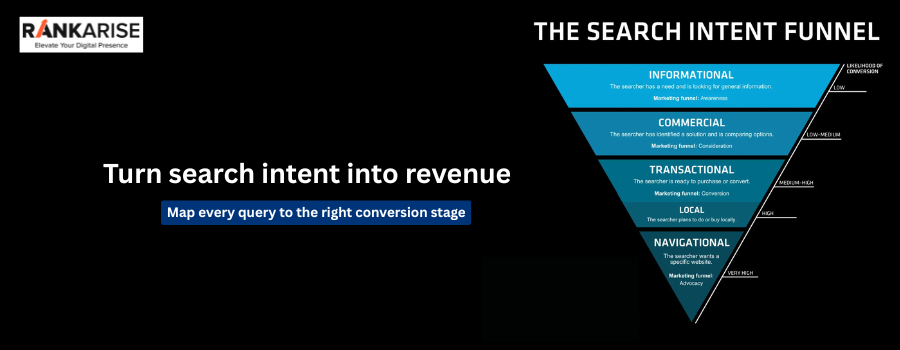
Most marketers stop at basic categories like:
- Informational
- Navigational
- Transactional
But that’s too shallow for real growth.
Advanced Intent Layers
To drive conversions, you need to go deeper:
- Problem Awareness – “Why is my website traffic dropping?”
- Solution Exploration – “Best SEO strategies for traffic recovery”
- Comparison Intent – “Ahrefs vs SEMrush”
- Purchase Intent – “Buy SEO tools subscription”
- Post-Purchase Intent – “How to use SEMrush for keyword research”
Each stage requires different content, messaging, and CTAs.
Why Most SEO Strategies Fail
Most websites fail not because of poor SEO—but because of intent mismatch.
Common Mistakes:
- Targeting high-volume keywords without understanding intent
- Using the same content format for every keyword
- Ignoring funnel stages
- Writing for algorithms instead of humans
Result?
Traffic increases
Conversions stay flat
why SEO alone is not enough for conversions
The Search Intent Mapping Framework
Let’s break down a practical, scalable framework you can implement immediately.
Step 1: Keyword Clustering by Intent
Stop treating keywords individually. Start grouping them based on intent patterns.
Example:
| Keyword | Intent Type |
| “what is SEO” | Informational |
| “SEO strategies 2026” | Commercial |
| “best SEO agency” | Transactional |
Pro Tip:
Use modifiers to identify intent:
- “how”, “what” → Informational
- “best”, “top”, “review” → Commercial
- “buy”, “price”, “service” → Transactional
Step 2: Map Keywords to Funnel Stages
Align every keyword with a conversion stage.
Funnel Mapping:
- TOFU (Top of Funnel) → Awareness
- MOFU (Middle of Funnel) → Consideration
- BOFU (Bottom of Funnel) → Decision
Example:
| Funnel Stage | Content Type |
| TOFU | Blog guides, educational content |
| MOFU | Comparison pages, case studies |
| BOFU | Landing pages, product pages |
Step 3: Match Content Format to Intent
Different intent requires different content formats.
Content Mapping:
- Informational → Blog posts, guides
- Commercial → Listicles, comparisons
- Transactional → Landing pages
If you mismatch format, conversions drop instantly.
Example:
- A “buy” keyword should NOT lead to a long blog—it should land on a conversion page.
Step 4: Build Intent-Based Content Architecture
Instead of random blogs, create a structured content system.
Content Hierarchy:
- Pillar Page (Broad topic)
- Cluster Pages (Subtopics)
- Conversion Pages (Money pages)
how to build a full-funnel SEO system
Example:
Pillar: SEO Strategy
→ Blog: “How SEO Works”
→ Blog: “SEO Tools Comparison”
→ Landing Page: “SEO Services”
This structure improves:
- Internal linking
- Topical authority
- Conversion flow
Step 5: Optimize for Micro-Conversions
Not every user converts instantly.
Track smaller actions like:
- Email signups
- Download clicks
- Time on page
These are intent signals that push users closer to final conversion.
Step 6: Align CTAs with Intent
Your CTA should match where the user is in their journey.
CTA Mapping:
- TOFU → “Learn More”, “Read Guide”
- MOFU → “Compare Tools”, “See Case Study”
- BOFU → “Book a Call”, “Get Started”
Wrong CTA = lost opportunity.
Step 7: Use Behavioral Data to Refine Intent
Intent isn’t static—it evolves.
Use tools like:
- Google Analytics
- Heatmaps
- Session recordings
Look for:
- High bounce rate → Intent mismatch
- Low conversion rate → Weak CTA or offer
- High engagement → Strong alignment
Step 8: Build Internal Linking Based on Intent Flow
Guide users through the funnel with strategic internal links.
Example Flow:
Blog (TOFU)
→ Comparison Article (MOFU)
→ Service Page (BOFU)
This creates a conversion pathway, not just isolated pages.
Step 9: Optimize for AI Search & Zero-Click Results
Modern search is changing fast.
To stay ahead:
- Answer questions directly
- Use structured headings
- Provide clear summaries
This improves visibility in:
- AI Overviews
- Featured snippets
- Voice search
Step 10: Measure Intent-Based KPIs
Forget vanity metrics—track what matters.
Key Metrics:
- Conversion rate per intent
- Revenue per page
- Funnel drop-off rate
- Assisted conversions
Real Example: Intent Mapping in Action
Let’s say you run a digital marketing agency.
Without Intent Mapping:
- Blog on “SEO tips”
- Generic CTA
- Low conversions
With Intent Mapping:
- Blog: “What is SEO?” → Awareness
- Blog: “Best SEO Tools” → Consideration
- Page: “SEO Services” → Conversion
Result:
Higher engagement
Better lead quality
3–10X conversion growth
Advanced Strategies for 10X Growth
1. Intent Gap Analysis
Find keywords where competitors rank but don’t fully satisfy intent.
2. SERP Intent Reverse Engineering
Analyze top-ranking pages:
- Format
- Length
- CTA style
Then improve on them.
3. Dynamic Content Personalization
Show different CTAs based on:
- User behavior
- Traffic source
- Device
Common Pitfalls to Avoid
- Ignoring search intent entirely
- Over-optimizing for keywords
- Using clickbait titles with mismatched content
- Treating all traffic equally
Conclusion
SEO in 2026 isn’t about ranking—it’s about alignment.
When your content matches:
- What users want
- When they want it
- How they want it
Conversions become inevitable.
The Search Intent Mapping Framework transforms your strategy from:
Traffic-focused
to
Revenue-driven
If implemented correctly, it doesn’t just improve results—it multiplies them.
FAQs
1. What is search intent mapping?
It’s the process of aligning keywords with user intent, funnel stages, and content types to maximize conversions.
2. Why is search intent important for conversions?
Because users convert only when content matches their needs. Misaligned content leads to high bounce rates.
3. How do I identify search intent?
Analyze keywords, SERP results, and modifiers like “best,” “buy,” or “how.”
4. What tools help with intent mapping?
Google Search Console, Ahrefs, SEMrush, and analytics tools.
5. Can this framework work for small websites?
Yes. In fact, it’s even more powerful for small sites because it focuses on quality over quantity.